
HyperbolicRAG: Curved Spaces, Better Answers — AI Innovations and Insights 94

Traditional RAG systems are pretty familiar by now: retrieve a few relevant passages using dense retrieval, then feed them to a language model for answering the question.
GraphRAG builds on this idea by turning documents into graphs, linking entities and passages, then using multi-hop propagation to improve reasoning. It feels more structured.
But here is a deeper problem: while the knowledge in these graphs is hierarchical, the embedding space they live in is flat…
Why Euclidean GraphRAG Isn’t Enough
Nearly all current graph-based RAG methods:
G-Retriever
GraphRAG (A Comprehensive Guide to Graph RAG)
HippoRAG (HippoRAG: Hippocampal Memory of RAG)
LightRAG (AI Innovations and Trends 03: LightRAG, Docling, DRIFT, and More)
HippoRAG2 (AI Innovations and Insights 31: olmOCR , HippoRAG 2, and RAG Web UI)
embed nodes in Euclidean space. That works well for capturing “how similar things are,” but this kind of space lacks a geometric notion of hierarchical depth. It can tell you that “chronic stress” and “acute stress” are similar, but it tends not to express that “stress” is a more abstract category that includes both.
This leads to some real issues.
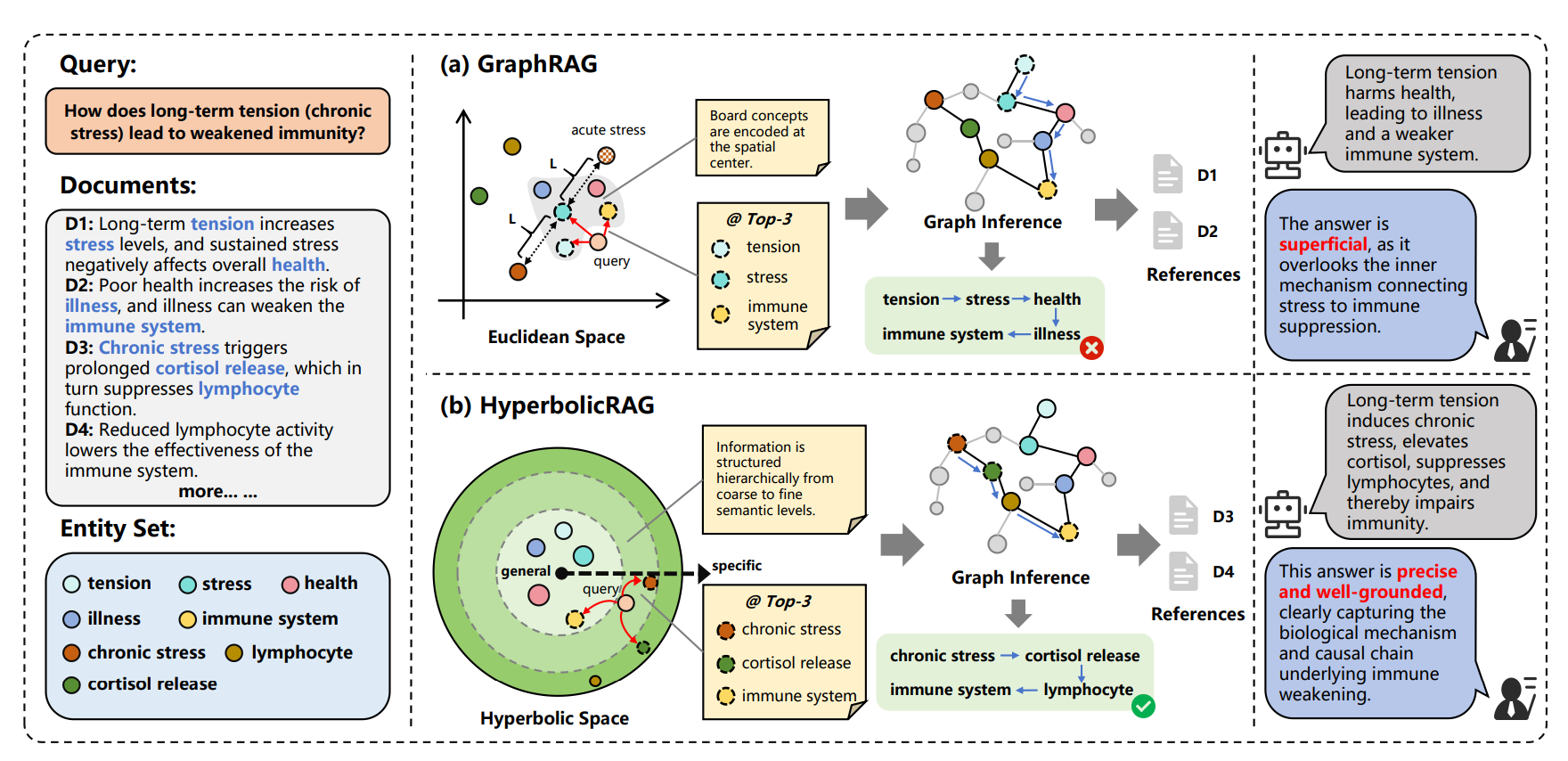
Imagine you’re asking a question like: How does long-term tension (chronic stress) lead to weakened immunity?
A Euclidean-based retriever is likely to pull in general terms like “health” or “illness”, broad concepts that appear in many contexts, because in high-dimensional Euclidean space, these hubs are close to everything. This is a well-known problem called hubness.
Keep reading with a 7-day free trial
Subscribe to AI Exploration Journey to keep reading this post and get 7 days of free access to the full post archives.