
Recently, there have been some developments suggest that ontologies are regaining attention.
Palantir describes the Ontology as the heart of its AIP architecture and as a unified representation of enterprise decision-making that integrates data, logic, action, and security. It models the “nouns” and “verbs” of operational processes in a form legible to both humans and agents.
Microsoft has also introduced an Ontology item in Fabric IQ, currently in preview. As of August 2026, its official documentation defines it as “a shared, machine-understandable vocabulary of your business”. Microsoft describes it as a shared business model used across teams, agents, and workflows in Fabric IQ, and as a context layer that Fabric agents and Real-Time Intelligence components can consume for consistent reasoning and actions.
A June 2026 Google Cloud case study describes how Yahoo’s Seller Agent uses a knowledge graph ontology to model advertising products, inventory, contracts, and governance controls. A separate decision-trace ontology structures an auditable context graph of agent decisions and outcomes. This is not a packaged ontology product, but it is a concrete example of ontology-backed semantics in an operational agent architecture.
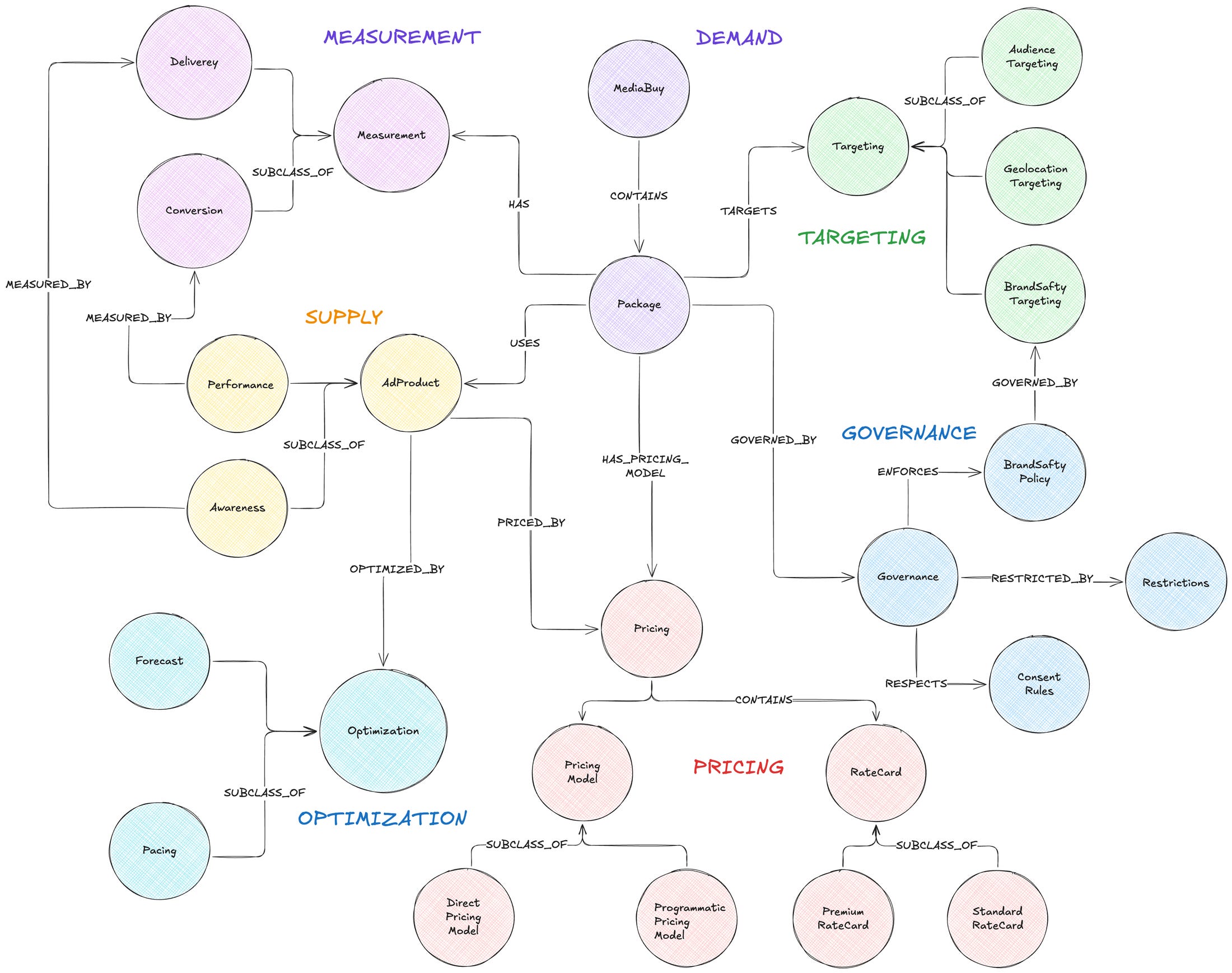
These examples show that ontology is being positioned explicitly inside enterprise AI and data platforms.
One distinction matters here. These platforms use ontology in a broader, product-specific sense than classical OWL-based ontology engineering.
Palantir’s Ontology is an operational platform layer that spans data, logic, actions, and security.
Fabric IQ presents ontology primarily as a governed business model and context layer connected to enterprise data.
Yahoo uses typed graph ontologies inside a specific agent architecture.
All three draw on ontology principles.
What Did Ontology Originally Mean?
Ontology has been part of AI and knowledge representation for decades. If you have ever worked with knowledge graphs, you have almost certainly come across it.
In computer science, an ontology is commonly understood as a formal, explicit specification of a shared conceptualization: a machine-interpretable vocabulary of concepts and relationships, together with axioms that define how they may be interpreted. W3C published OWL as a Recommendation in 2004 and OWL 2 in 2009, followed by a second edition in 2012. The OWL family became a central ontology-language standard in the Semantic Web stack.
A useful distinction is that an ontology defines shared vocabulary and axioms for a domain, while a knowledge graph primarily records entities and relationships, often using that ontology as a schema. For example:
Ontology/schema: Customer → places → Order; Customer → locatedIn → Location.
Knowledge graph: Florian → places → Order_91827; Florian → locatedIn → London.
Next, let’s look at why Ontologies are finding new life in the age of LLMs.
LLMs and Ontologies Can Complement Each Other
This shows up in two main ways.
LLMs Can Reduce the Initial Ontology-Drafting Burden
Historically, one of the biggest problems with Ontology was not that the theory was bad. The real problem was much simpler: It was too expensive.
Building an ontology typically required both an ontology engineer and a domain expert: identify concepts → define classes → define the hierarchy → define relations → define constraints → alignment → validation → maintenance. This process demanded a huge amount of manual work.
LLMs can assist with several parts of this workflow, including concept extraction, entity and relation extraction, schema drafting, and the generation of initial OWL representations.
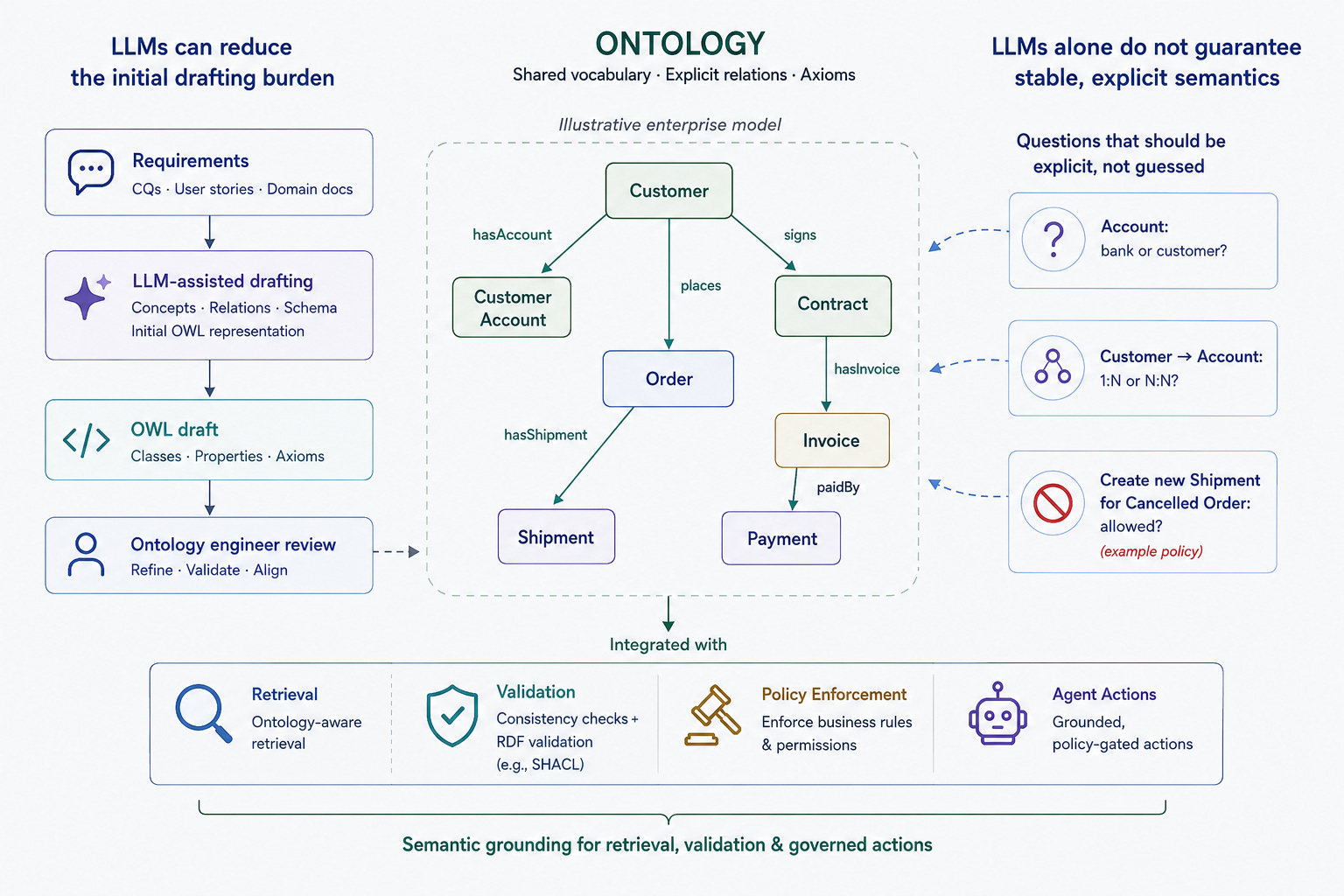
In recent years, studies were already using LLMs to generate OWL ontologies directly from competency questions and user stories:
An ESWC 2025 study introduced a benchmark of ten ontologies, 100 competency questions, and 29 user stories. In a separate incremental experiment on three course ontologies covering 45 questions, o1-preview with Ontogenia modeled more questions than novice student submissions, but still produced incorrect axioms and redundant elements. At the same time, the study noted that errors and variation between outputs were still a real issue.
Another study tested DeepSeek and o1-preview on automatic domain ontology generation across six domains. The results showed a certain degree of generalization across different domains.
This creates a surprisingly interesting feedback loop.
Before: Ontology highly valuable → but too expensive to model → hard to adopt at scale.
Now: LLMs may reduce the initial drafting burden → the resulting ontology can be integrated into retrieval, validation, and policy mechanisms that ground model outputs and gate agent actions.
I think this is the deeper reason Ontology may genuinely be heading for a second life.
LLMs Can Talk, but They Do Not Have a Stable “World Model”
Imagine an enterprise has concepts such as: Customer, Account, Contract, Invoice, Payment, Product, Region, Employee, Supplier
An LLM can read hundreds of PDFs and develop a rough understanding of what these concepts mean. But important questions quickly appear:
Does Account mean a bank account or a customer account?
Is the relationship between Customer and Account 1:N or N:N?
Does Invoice depend on Contract, or does Contract depend on Invoice?
Can a Cancelled Order still have a Shipment?
Can a Sales Rep modify a Contract?
A model cannot be left to answer questions like these based on its own intuition.
These questions should not be answered from model priors alone. An ontology can provide a shared vocabulary and explicit relationship semantics, helping address this problem.
Ontology, RAG, and Agents
RAG Could Find Relevant Information, but It Didn’t Really Understand the Enterprise
The first generation of enterprise LLM systems largely followed this architecture: Documents → Chunking → Embedding → Vector DB → Retrieval-Augmented Generation.
This architecture works well, but at its core, it mainly answers one question: “Which passages are likely to be relevant to this question?” It does not explicitly capture the identities, relationships, constraints, and lifecycle rules of enterprise objects.
A growing family of AI systems is moving beyond flat document retrieval by incorporating knowledge graphs, Ontologies, and other semantic structures to organize information and guide retrieval and reasoning.
EMNLP 2025 included Ontology-Grounded RAG (OG-RAG), which maps documents into ontology-grounded factual blocks and hyperedges, then uses that structure to guide compact context retrieval.
Ontology-Guided Reverse Thinking (ORT, ACL 2025) and OntGQA (ACL 2026) also featured KGQA systems that use ontology-level type or schema graphs to guide multi-hop search over Freebase. Here, ontology refers mainly to the knowledge graph’s type or schema layer, not necessarily to a full OWL ontology.
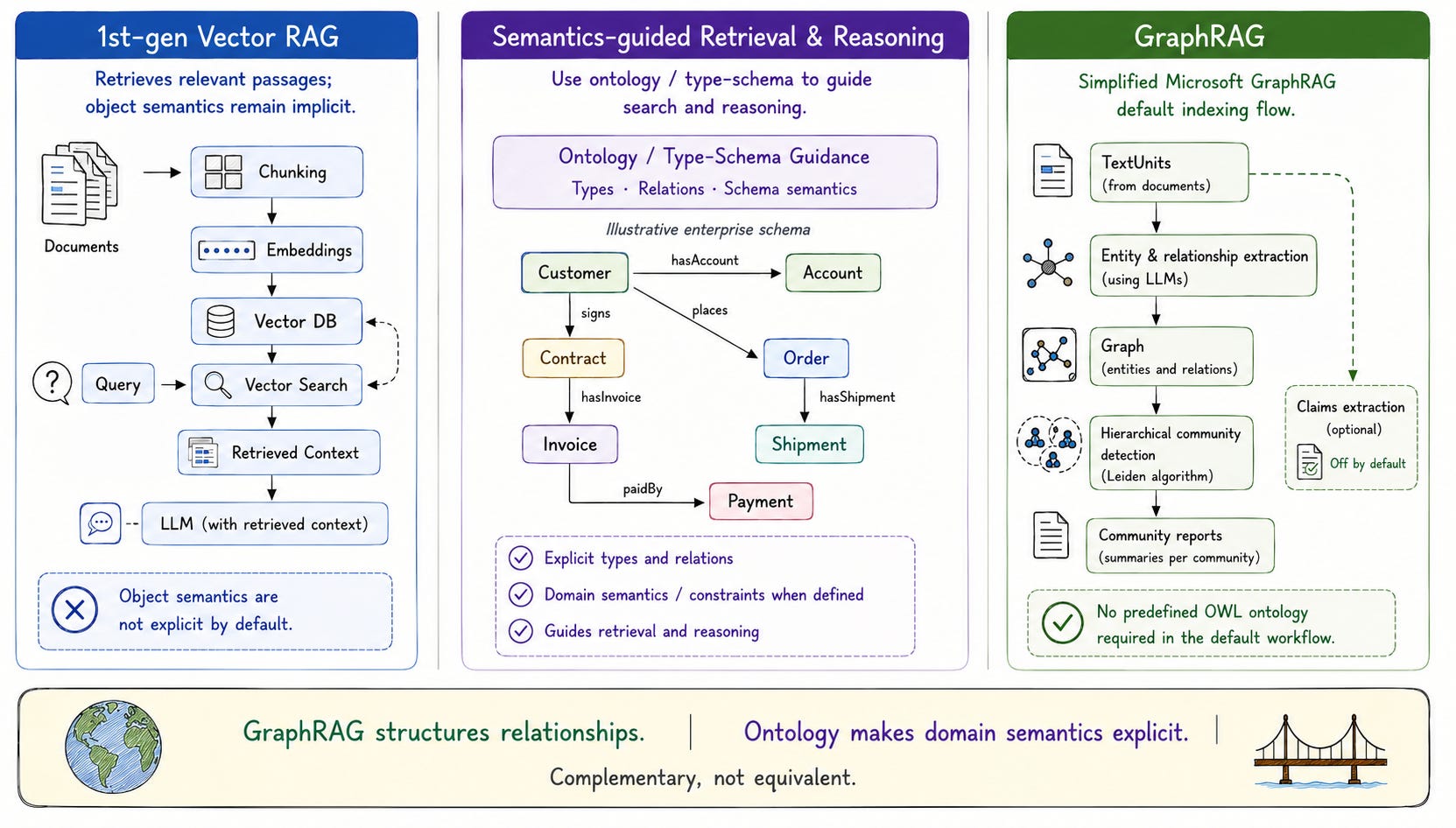
But these examples should not be taken to mean that every graph-based RAG system is ontology-based. GraphRAG ≠ Ontology.
In its default indexing workflow, Microsoft GraphRAG uses LLMs to extract entities and relationships from text, builds a graph, detects hierarchical communities with Leiden, and generates community reports. Claim extraction is optional and disabled by default. It does not require a strict OWL ontology to be defined in advance.
A more accurate way to think about the relationship is: GraphRAG gives an LLM a “graph.” Ontology gives that graph stable “semantics.”
Agents Increase the Value of Explicit Semantics and Governance
I think this is an important reason behind the current revival.
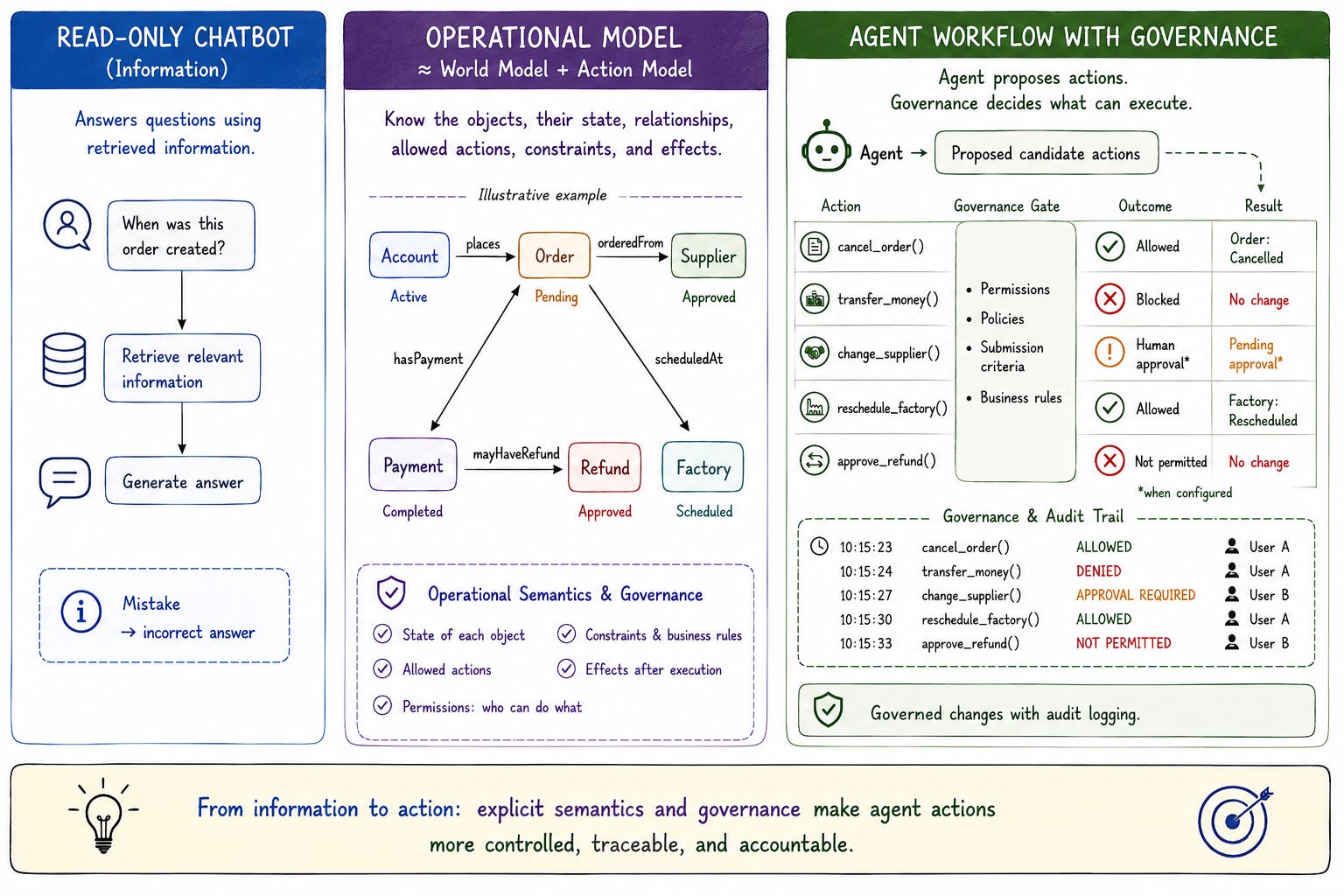
If a chatbot gets something slightly wrong: “This order was probably created last year.” That may simply result in an incorrect answer.
But if an Agent gets something slightly wrong:
cancel_order()
transfer_money()
change_supplier()
reschedule_factory()
approve_refund()
The stakes are completely different.
An agent system needs to know: What objects exist? → What state is each object in? → How are those objects related → What actions are allowed? → Who is allowed to perform them? → What constraints apply to those actions? → What happens after an action is executed?
This is already very close to a classic AI idea: World Model + Action Model.
This is one reason Palantir’s Ontology fits agentic workflows well: it models not only objects and links, but also actions as first-class operational primitives. With the appropriate Ontology binding and scoped permissions, Palantir agents can query Ontology objects and invoke exposed, predefined actions that apply governed changes to Ontology-backed data.
So I think agentic AI is one important catalyst behind ontology’s renewed visibility.
Thoughts
I think the evolution of AI infrastructure over the past two years can be understood roughly like this: prompt design, retrieval grounding, tool-using agents, broader context engineering, and renewed interest in structured semantic models (Ontology / Knowledge Graph).
As foundation models improve, many enterprise systems increasingly encounter another bottleneck: whether the surrounding system provides explicit, current, and governed knowledge about the environment in which the model operates.
These are long-standing problems in knowledge representation, and formal ontologies have addressed part of them since the early 1990s.
But in my view, the likely future is not a simple return to OWL. A more promising direction is an ontology-backed semantic and operational layer that connects domain models with current data, retrieval, action contracts, policies, and runtime controls. Ontology provides shared meaning, while the surrounding system provides state, enforcement, and execution. In that broader sense, the combined layer can function as a kind of “semantic operating system” between AI systems and enterprise resources.