
Agent skills evolving is currently an exciting new direction. I’ve previously written several articles introducing this topic (AI Exploration Journey: Skills).
Today, let’s explore a framework for evolving agent skills specifically designed for the multi-user OpenClaw ecosystem.
The Limitations of Existing Skill Methods
Every day, LLM agents interact extensively with users, continuously accumulating experiences. Yet, these experiences rarely contribute meaningfully to enhancing the overall system.
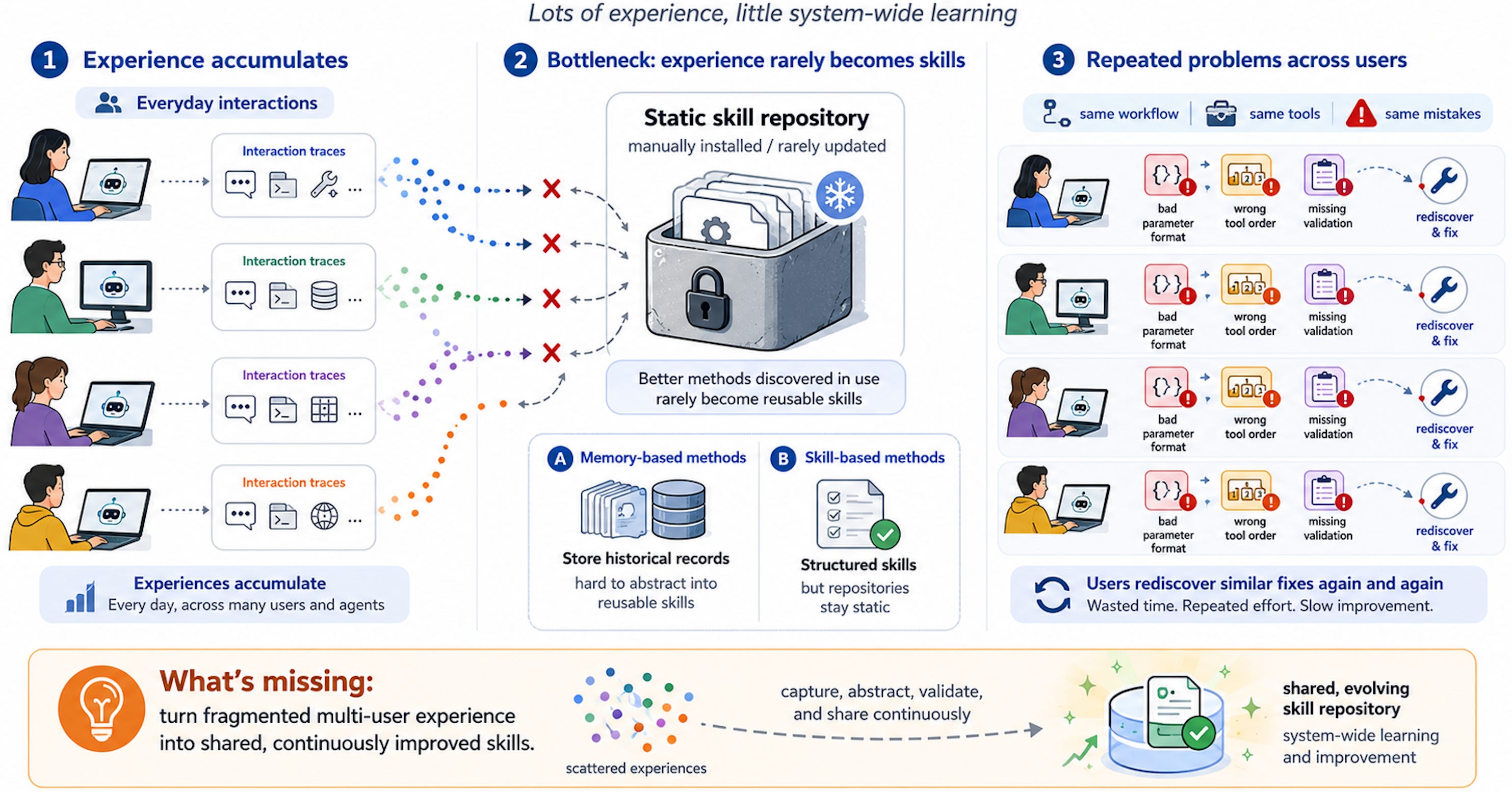
To clarify further:
Agent skills today are largely static. Typically, skills are manually installed and maintained. Once deployed, they seldom change. Even if an agent discovers better methods through actual usage, these improvements rarely make it beyond the current interaction and rarely enter the skill repository.
Different users repeatedly encounter similar issues. Users often face similar workflows, call similar tools, and even make similar mistakes like incorrect parameter formats, improper tool invocation sequences, or missing validation steps. However, the system doesn’t integrate these recurrent success patterns or failure modes across users and over time. As a result, many users end up rediscovering similar fixes independently.
Existing solutions fall short. Memory-based methods typically just store historical records for easier retrieval, but they struggle to abstract these into genuinely reusable or improvable skills. Conversely, skill-based methods do structure experience into skills, but these repositories are usually static and do not evolve naturally through ongoing use.
If individual users’ fragmented experiences from multiple interactions could be transformed into skills shared and continuously enhanced across the entire multi-user agent system, the impact would be significant. Validated improvements discovered in one context can be propagated through the shared skill repository, so future agents that use the relevant skills can benefit from collective experience.
SkillClaw's Architecture: A Closed-Loop Pipeline for Collective Evolution
As shown in Figure 2, SkillClaw gathers interaction traces from daily multi-user agent usage, evolves them into improved skills, and then synchronizes these enhanced skills back to all agents, forming an automated feedback loop.
